

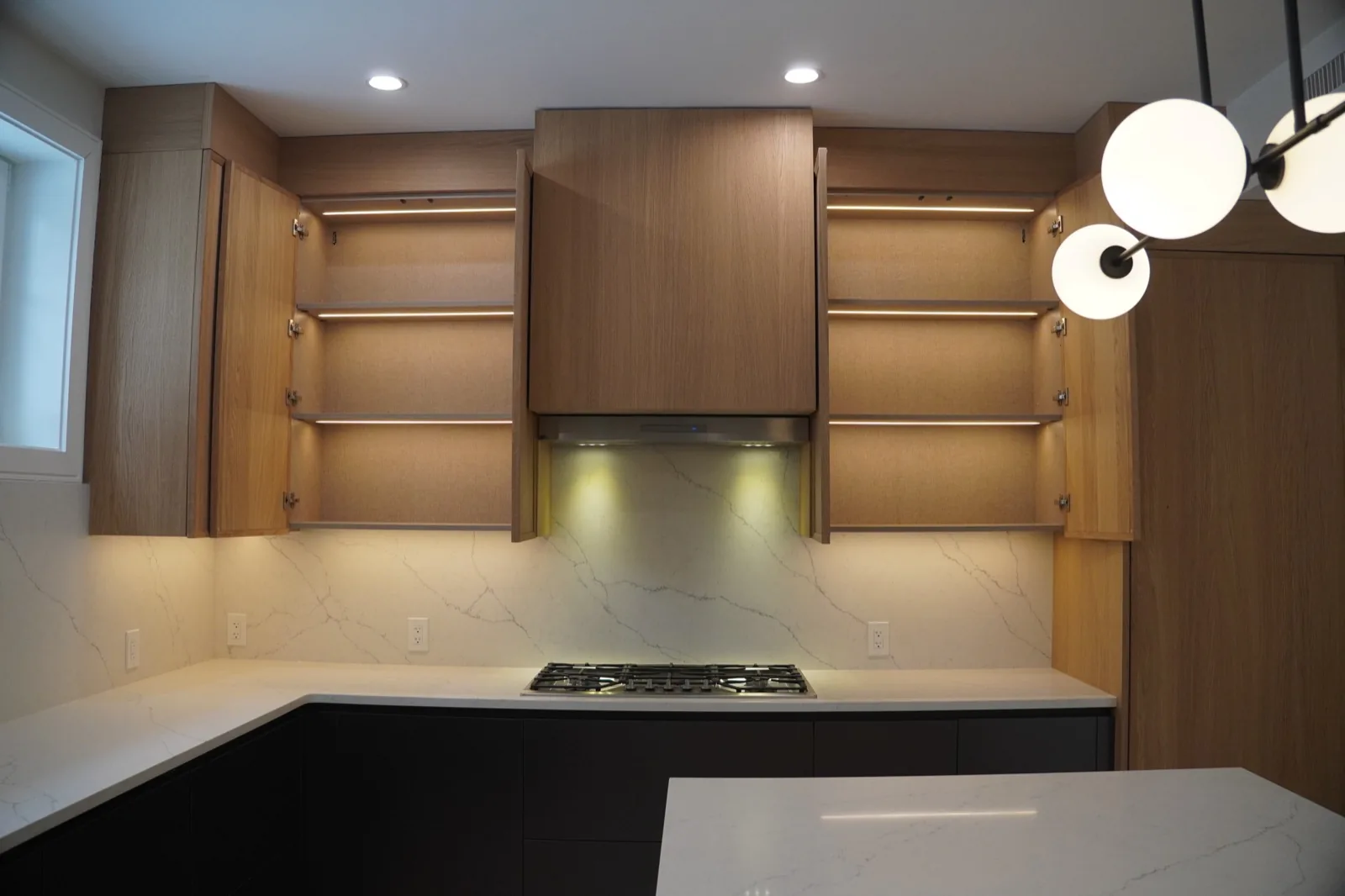
This gets framed as a matter of taste, with drawers coded modern and doors coded traditional. That framing is not much help, because in practice you are not choosing once. You are choosing separately for every cabinet in the room, and the right answer changes depending on what goes inside.
Underneath the aesthetic question there is a mechanical one that decides most of it. A door leaves the contents in a box and asks you to enter it. A drawer brings the contents out to where you are standing. Everything downstream of that, including the cost difference, follows from the fact that a drawer is doing more work.
This page covers where the extra cost comes from, which cabinets justify it, and two related decisions that people usually meet at the same time: frameless against framed construction, and a manufactured system against fully bespoke joinery.
Where the cost difference comes from
It is worth understanding the mechanism, because it tells you which drawers are expensive and which are not. Four shallow drawers and one deep drawer occupy the same opening, and they are not the same order.
Boxes inside the box
A door cabinet is one carcass with a shelf in it. A drawer bank of four is one carcass plus four separate drawer boxes, each with its own sides, base and back.
A runner set per drawer
Every drawer rides on a pair of runners rated for its load and depth. A door cabinet needs two hinges for the whole opening. The hardware count is where most of the difference sits.
Fronts that have to align
Four drawer fronts stacked in one opening have to keep their gaps even across the whole height. That is a tighter tolerance than a single door, and it takes longer to set at installation.
Interior fittings
Drawers invite dividers, pegboards, cutlery inserts and knife blocks, and those are usually priced separately. A shelf is a shelf.
We do not publish prices on this site, and any figure you find in a kitchen article is describing a different specification from yours. What transfers between projects is the mechanism above. If you want the difference for your own kitchen, the number comes from your drawings and your specification, not from an average.
Choosing cabinet by cabinet
Run this table against your own plan rather than adopting a house style. Most well-resolved kitchens end up mixed, and the mix is not a compromise.
| Cabinet | Usually | Reasoning |
|---|---|---|
| Base run, everyday items | Drawers | You are storing things you reach for daily at a height you would otherwise have to crouch to. A drawer removes the crouch and shows you the whole contents at once. |
| Base run, pots and pans | Deep drawers | Heavy items are safer moving horizontally toward you than being lifted out of a low box at arm's length. |
| Narrow cabinet, under 400 mm | Drawers, and check the carcass | A face frame takes a fixed bite out of every opening, so the narrower the cabinet the larger a share it takes. Frameless construction gives you close to the full internal width. |
| Tall items and small appliances | A door | A stand mixer, a stockpot or a sheet tray needs vertical clearance and a full-height opening. Drawers divide that volume into layers you cannot use. |
| Wall cabinets | A door | Above the counter you are reaching up into the cabinet anyway, and a drawer at that height would need to be pulled down. This is one place the traditional answer is simply correct. |
| Under the sink | A door, usually | The trap, the waste and the shut-off valves occupy the middle of the cabinet. Purpose-made sink drawers exist and are cut around the plumbing, but a door remains the simpler answer. |
| The corner | Neither, on its own | A corner base needs a mechanism to bring its contents to the opening. Without one, most of that volume is unreachable regardless of what is on the front. |
Construction
Frameless or framed changes what you are buying.
European frameless cabinets attach hinges, drawer systems and doors directly to the cabinet box. American framed cabinets add a structural face frame across the front, and inset cabinetry is a framed style where the doors and drawers sit inside that visible frame.
Without a face frame around each opening, frameless cabinets give direct access to drawers, pullouts and shelves. The practical difference shows up most in narrow cabinets and in storage zones you have organised tightly, because the frame takes a fixed width out of every opening whether the cabinet is wide or not.
No system is automatically better for every project. Frameless suits continuous architectural elevations and precise modern detailing. Framed and inset cabinetry can be the right call when a project specifically wants traditional reveals and furniture-like door relationships. Choose by architectural intent rather than by geography, and read the longer version in our note on European frameless cabinets.
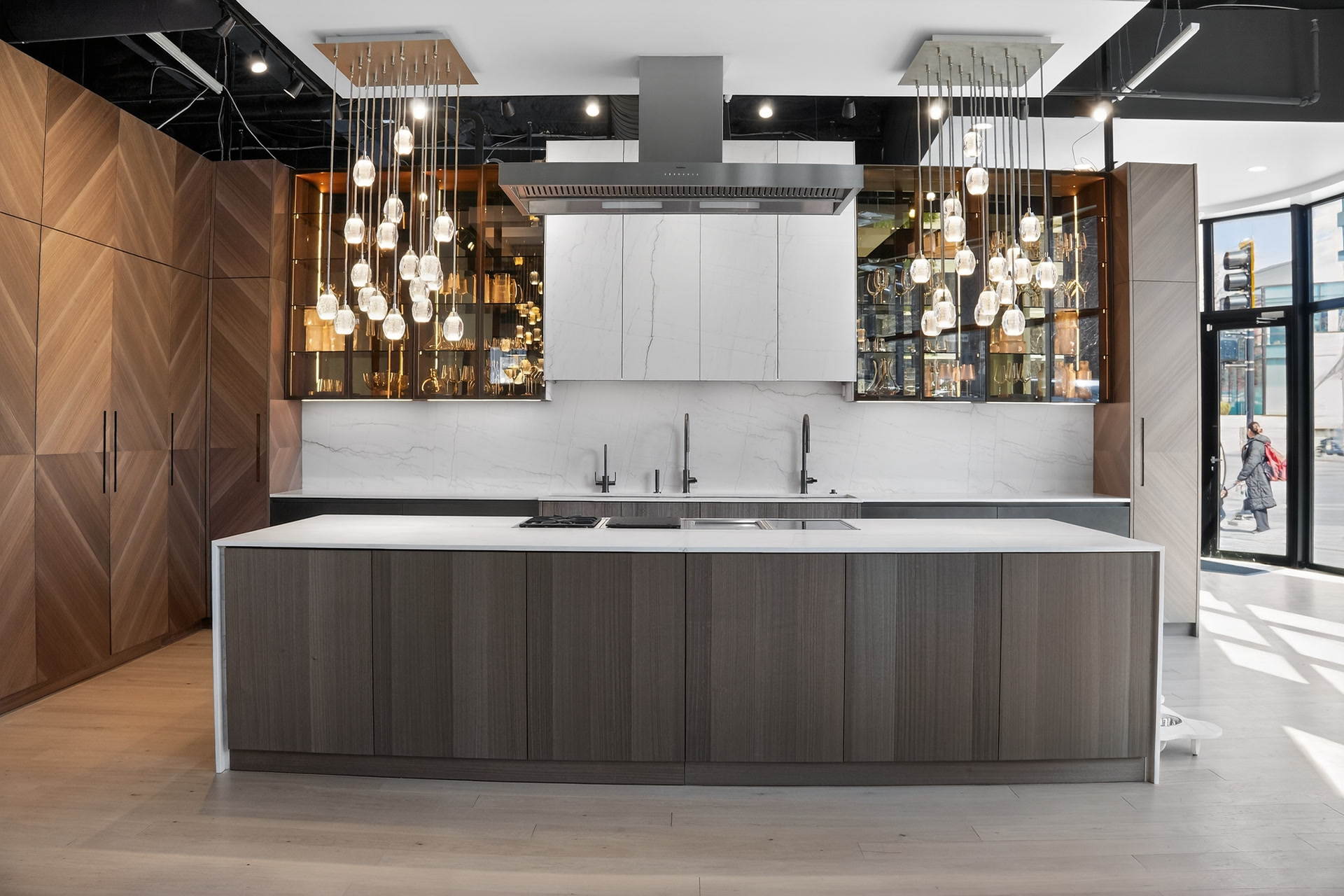
Made to order is not the same as off the shelf
Custom against modular is usually presented as a straight trade between freedom and budget. That description fits a flat-pack range and a joiner's workshop, and it fits almost nothing in between, which is where most European cabinetry actually sits.
A manufactured cabinet system is engineered once and configured per project. The carcass construction, the runner loadings, the hinge geometry and the way panels meet have already been resolved and tested, and your kitchen inherits that. What varies is the configuration: which cabinets, at what dimensions, in which finish, arranged for your room. DOCA Boston works with made-in-Spain cabinetry systems on exactly that basis.
Fully bespoke joinery gives you freedom the system does not have, and it hands you the engineering the system had already solved. That is the right trade when the room demands geometry no catalogue covers, and the wrong one when the room is ordinary and the requirement is really about precision.
Either way the coordination is the same. Field conditions get verified, drawings get approved, appliances get confirmed against their own installation documents, and somebody owns delivery and installation. Our project process sets out how those handoffs run.
Common questions about drawers and cabinets
Are drawers more expensive than cabinets?
For the same cabinet width, yes, a drawer bank generally costs more than a door cabinet. The reason is part count rather than anything to do with quality. A door cabinet is one box, a shelf and a pair of hinges. A four-drawer bank is the same box plus four separate drawer boxes and four sets of runners, and each of those runners is a load-rated mechanical component. Interior dividers add to it again. The gap depends entirely on the specification, so it is worth pricing your own drawings rather than working from a rule of thumb.
Should the whole kitchen be drawers then?
No, and a kitchen that is all drawers is usually a kitchen that has stopped thinking about what is being stored. Tall items lose their volume, wall cabinets become awkward, and you pay for mechanisms in places where a shelf would have done. Decide cabinet by cabinet based on what goes in it.
What is the difference between European frameless and traditional framed cabinets?
European frameless cabinets attach hinges, drawer systems and doors directly to the cabinet box. American framed cabinets add a structural face frame across the front, and inset cabinetry is a framed style where doors and drawers sit inside that visible frame. Frameless gives more usable interior for the same external width and suits continuous, quiet elevations. Framed and inset suit projects that want traditional reveals and a furniture-like relationship between door and frame.
Is custom cabinetry better than a modular European system?
They are not really opposites. A European system is engineered as a system and configured to the project, which gives you the repeatability of manufacturing with a plan drawn for your room. Fully bespoke joinery gives you freedom in geometry that a system does not, and it takes on the engineering that the system had already solved. The honest question is whether your room needs geometry a system cannot produce, or whether it needs a system executed well.
Which is better for a small kitchen?
Drawers, in the base run, with a frameless carcass. Small kitchens punish wasted volume more than large ones do, and the two things that waste volume are unreachable depth and a face frame narrowing every opening. See our guide to planning a compact kitchen for the rest of that argument.
Related reading: kitchen ergonomics for the reach argument in full, compact kitchens if the room is tight, and American versus European kitchen design for the wider comparison.