

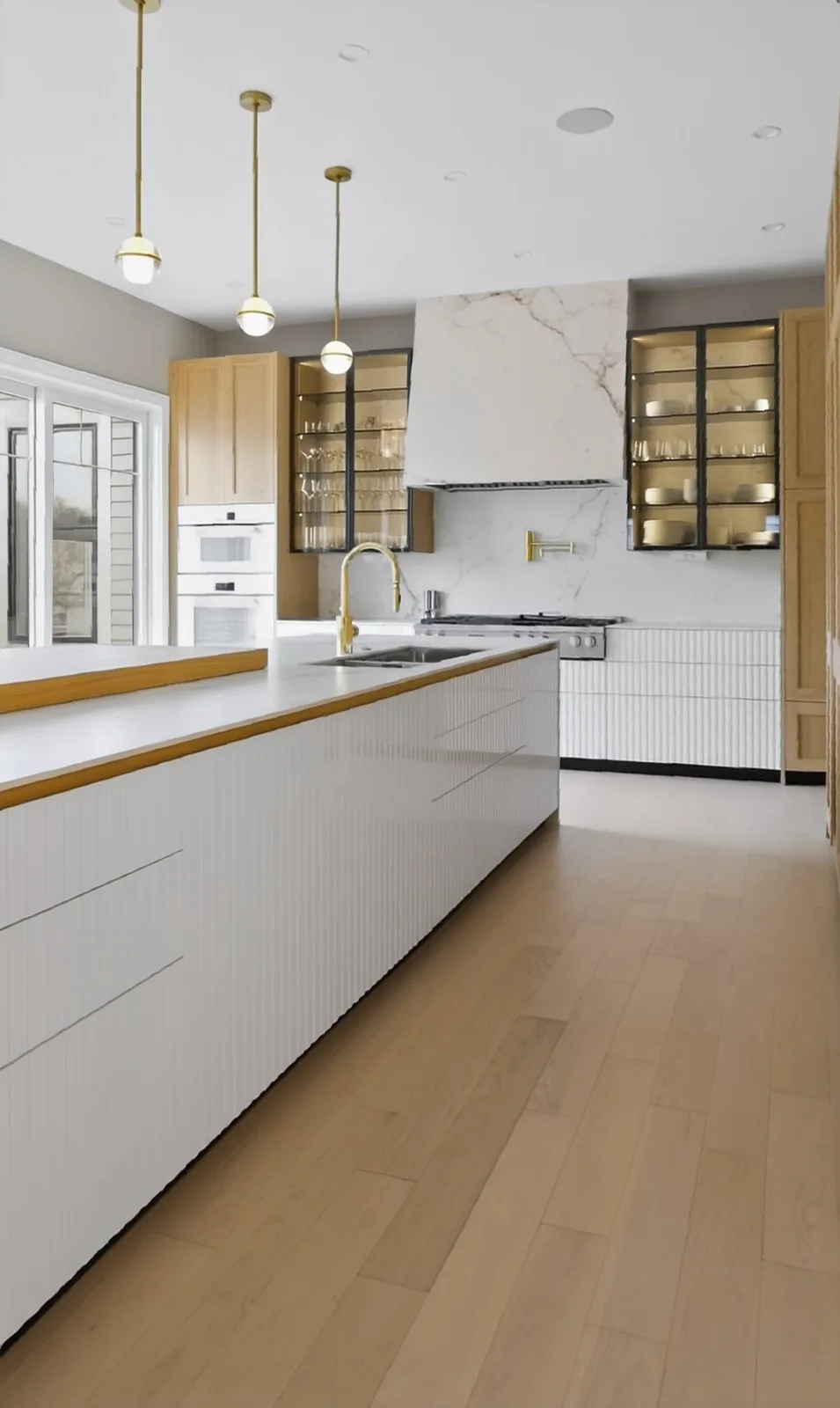
Saying that plainly is more useful than implying a separate product line. Three things change in a coastal project: the finish palette, the way the room handles daylight, and how much hardware stays visible. Everything behind the door is the same system.
The rest of this page covers what those three changes actually require, and the one decision that people near the water get wrong most often.
Surfaces
Finish and material
The palette runs pale and warm rather than pale and cold. Bright white or ivory lacquer handles the volumes that should disappear, natural oak keeps the volumes that should stay warm, and one darker tone stops the room flattening out in strong daylight.
Worktops are porcelain, and in a room this bright the material is earning its place practically rather than decoratively. A large-format sheet runs from counter up through backsplash with no seam to catch the light on a wall the sun rakes across all afternoon. What is installed in Brookline is porcelain; slab, edge, seam and fabrication are confirmed against the product chosen.
Daylight
What the light does to a finish
A waterfront room gets direct light and light reflected off water, and it gets both from angles an inland room never sees. That is the decision most coastal kitchens get wrong.
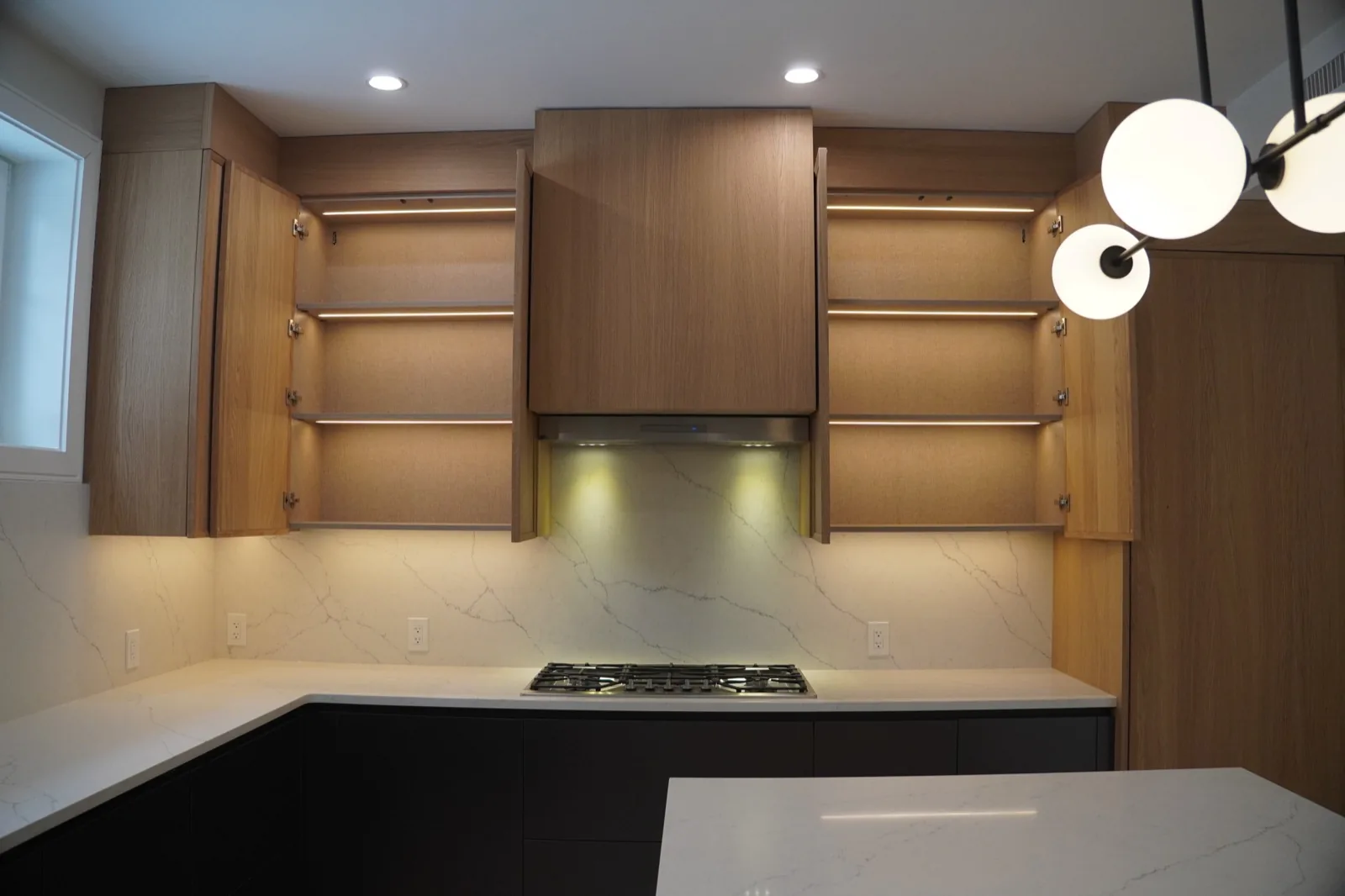
Gloss lacquer that looks calm under showroom lighting can become a mirror in that room. Matte lacquer and a light oak with visible grain hold up better, because texture absorbs some of what a flat gloss surface throws back.
This is the strongest single reason to see finishes at full scale before committing. A small sample cannot show you what an entire wall of the same finish does at four in the afternoon in July, and by the time you find out, the cabinets are installed.
Hardware
One metal, used consistently
Warm metal against pale cabinetry photographs well and can read busy in a real room at midday.
The safer decision is one metal used consistently across the room rather than a mix that looks collected. Brass hardware with pendant lighting is DOCA's own coastal vocabulary, and it works when it is the only metal doing the talking.
Interiors
Storage and interior fittings
Houses near the water tend to have a different storage problem from a year-round city kitchen. There is more seasonal equipment, more entertaining compressed into a short window, and more people moving through the room at once.
That usually argues for a larger concealed pantry and a beverage zone that can be closed, rather than for more base drawers. Both are cabinet decisions made before production.
Appliances
Appliance integration
Panel-ready refrigeration keeps a pale elevation continuous, which matters more here than elsewhere because there is less visual noise to hide a stainless front behind.
As everywhere else, the panel is cut to the appliance rather than the appliance fitted to the panel, so the schedule closes before cabinets are released.
Fit
Where coastal actually works
Coastal reads best in rooms with real daylight and a view worth deferring to, where the architecture is already doing the work and the cabinetry should stay quiet.
In a dark inland room the same palette tends to look washed out rather than light. The palette is not the thing that makes a coastal kitchen work. The light is, and the palette is what responds to it.
Budget
What moves the cost
One variable is specific to this direction, and it is the porcelain. The rest are the same drivers as any other DOCA kitchen.
- 01
The size of the porcelain sheets, and how many seams the layout manages to avoid.
- 02
The linear feet of cabinetry.
- 03
How many finishes are asked to share one room.
- 04
How much of the storage closes behind a mechanism instead of a hinged door.
- 05
How many appliances are panelled.
- 06
How much of the lighting is built into cabinetry rather than hung from the ceiling.
Completed work
Waterfront work in New England
Swampscott New Construction
The one documented waterfront project on this site. Expansive glazing and curved architecture, which is exactly the light condition this page is about.
Cashmere Palette, Wellesley
Stained oak and lacquer held to a narrow palette across several rooms, which is the discipline a pale scheme depends on.
Continue planning