

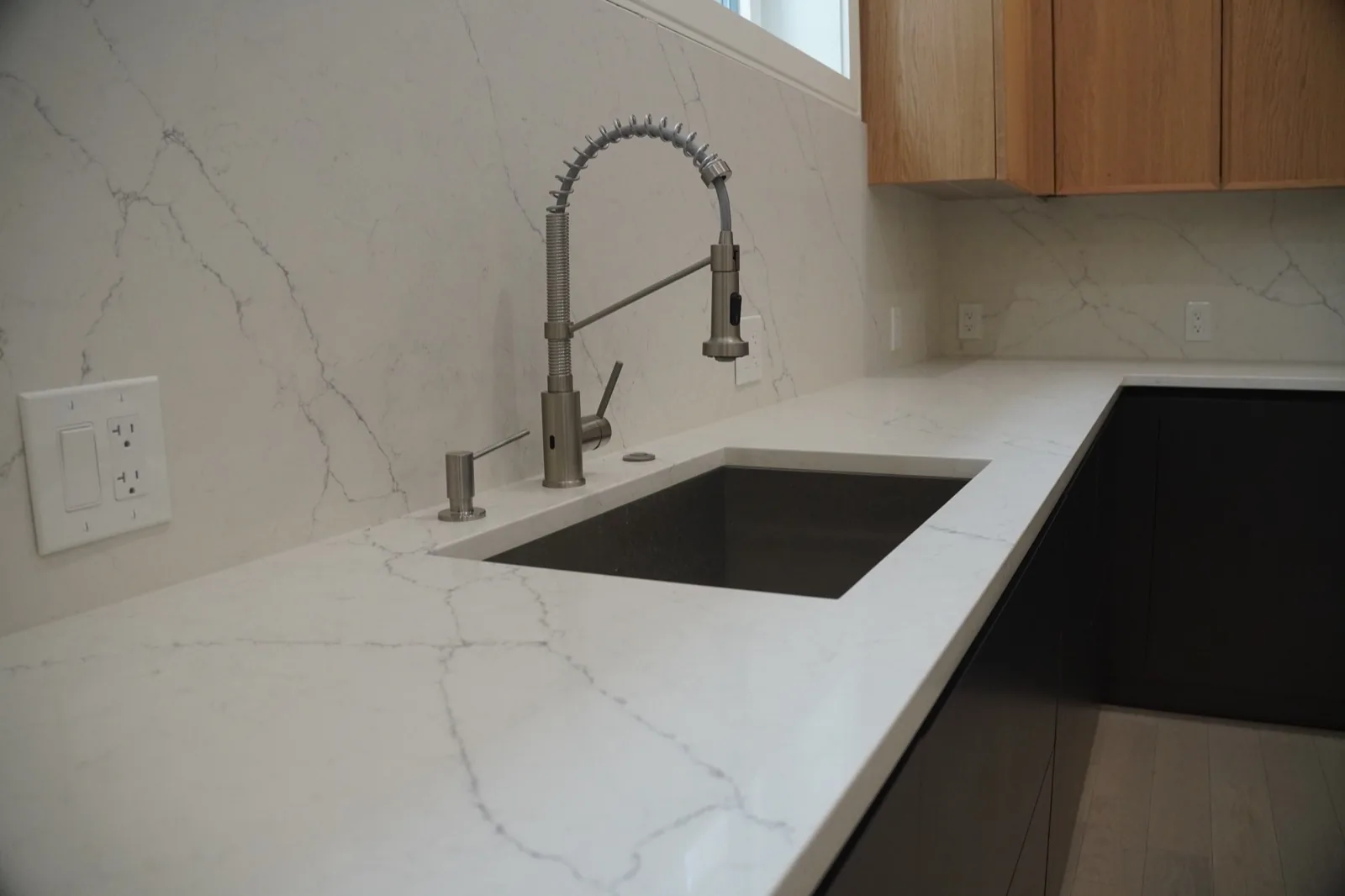
For a high-use kitchen, porcelain and sintered-stone surfaces are frequently worth evaluating when you want a mineral look with a carefully controlled edge expression. Natural stone brings variation that no printed pattern can duplicate. Engineered quartz and compact laminate can suit the right brief, but each has its own fabrication, care and detailing requirements.
At DOCA Boston, the offer is a design-led cabinetry and whole-space conversation. It is not a promise to fabricate or supply every surface. In a consultation, we can help align cabinetry, appliance integration, surface direction and the decisions your fabricator or project team needs to resolve.
Material comparison
Choose for the room, then verify for the project.
Performance claims belong to a specific product and installation. This is a selection framework, not a substitute for a manufacturer data sheet or fabricator review.
| Material | Good fit when | Project review |
|---|---|---|
| Porcelain / sintered stone | Continuous visual surfaces, thin-edge expressions and active kitchens | Review the exact slab, thickness, edge build-up, seam plan and fabricator details before specifying. |
| Engineered quartz | A consistent engineered appearance with a broad palette | Confirm the exact product, fabrication plan and the fabricator's silica-control practices; product composition varies. |
| Natural stone | A singular slab and material variation | Discuss porosity, sealing, edge support, movement and the maintenance expectations for that particular stone. |
| Compact laminate | A lighter, thin-profile worktop direction | Check the selected product's heat, moisture, joint and edge requirements; do not treat it as interchangeable with stone. |
What has lasting value
Six durable European countertop directions.
Six directions, each one grounded in proportion, material behaviour and how the surface meets the cabinetry. They are ordered by how often they decide a project rather than by how new they are.
Thin visual profiles
A worktop can appear light without being structurally casual. The visible edge, substrate, cantilever and appliance reveals must be resolved together.
Porcelain continuity
Porcelain can continue from worktop to backsplash, waterfall or cladding where the selected slab and fabrication plan support the intended composition.
Natural variation
Natural stone gives a kitchen an unrepeatable surface. The question is whether its movement, porosity and care expectations fit the life of the room.
Quiet, compact surfaces
Compact laminate and other panel-based solutions can support a slim, restrained direction when their joints, edges and heat exposure are designed honestly.
Material contrast
Warm veneer, quiet lacquer, glass or metal can keep the countertop from doing all the visual work. One dominant material usually reads more considered than several competing ones.
Integrated function
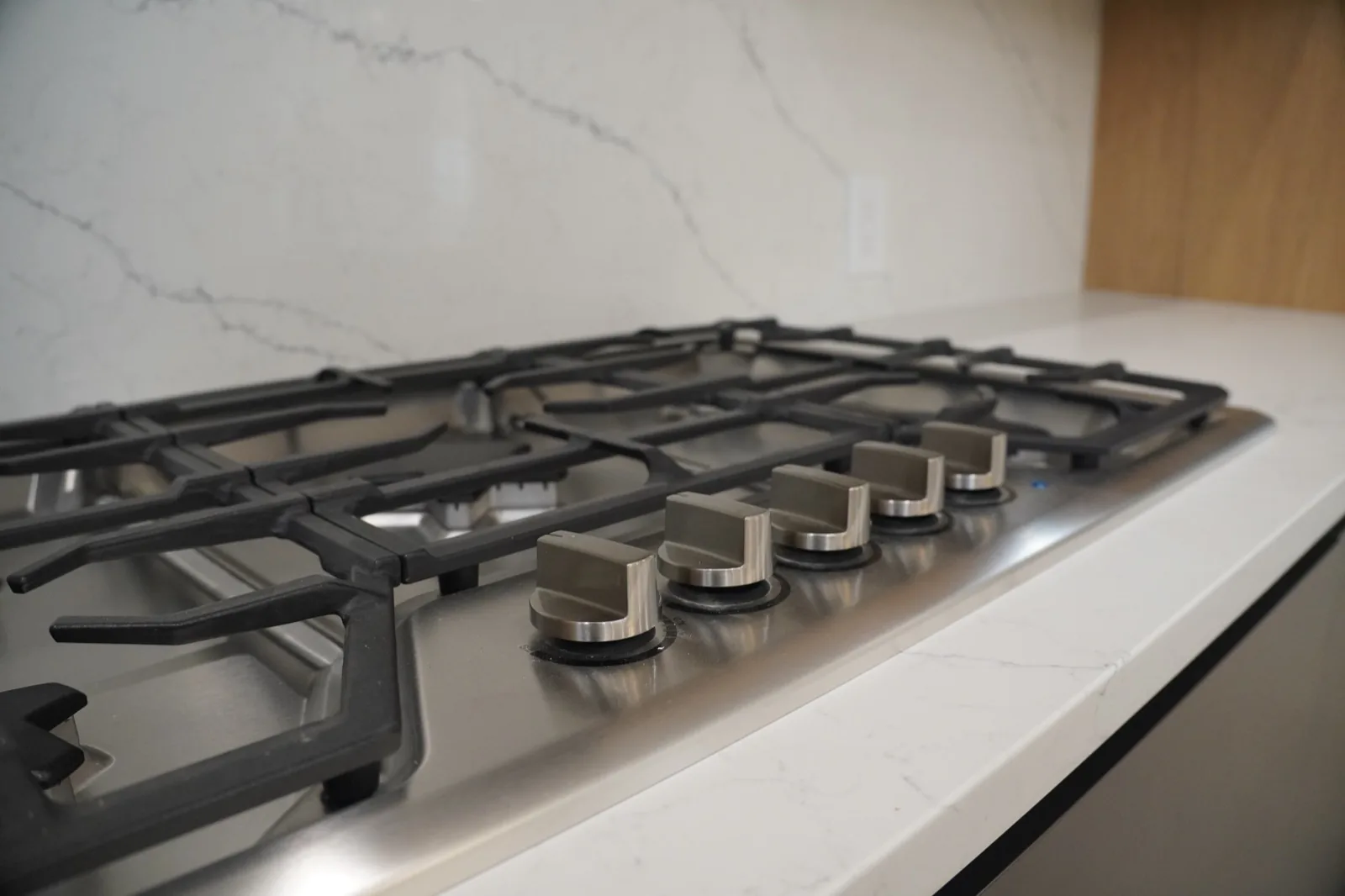
Sink type, cooktop, ventilation, seating and storage are part of the surface decision. European kitchens are strongest when those interfaces feel intentional.
A material note
“Durable” is not a specification.
Manufacturers publish product-specific information on heat, staining, scratching, thickness and care. For example, sintered-surface brands document high heat, stain and scratch resistance, but those statements do not eliminate the need to confirm the selected product and fabrication details.
For quartz and stone fabrication, safety is a project responsibility as well: OSHA identifies silica-dust exposure during cutting, grinding, drilling and polishing as a serious worker-health risk. The finished countertop is not the issue; safe fabrication methods are.
To test a claim, read the technical literature for the named product. A general material label does not carry that detail. Cosentino's Dekton technical manual is one example; the selected manufacturer and fabricator should supply the relevant documentation for the final choice.
Selection rubric
Bring these four decisions to the first material review.
A productive consultation narrows the questions before a final material is promised.
- 01
Resolve the cabinet elevation first
Worktop thickness, overhangs, panel alignment and appliance reveals affect the cabinet composition. A material is not an isolated finish.
- 02
Look at a full-size sample
Veining, reflectance, texture and edge build-up read differently at slab or door scale than on a small chip.
- 03
Map the use points
Cooking, prep, sink, seating, island joints and vertical cladding may each place different demands on the selected product.
- 04
Confirm the technical package
The selected manufacturer, slab, fabricator and project team should confirm thickness, support, cutouts, seams, care and safe fabrication methods.
Boston and New England
Plan for the actual site.
Older homes, tight urban access, field conditions, existing walls and the construction sequence can matter as much as the slab. Confirm who owns dimensions, substrate readiness, appliance cutouts, delivery access, fabrication and installation before production begins.
DOCA's process is designed to surface these interfaces early. The cabinetry plan, selected appliances and countertop direction should be coordinated before the room is committed.
Related decisions