

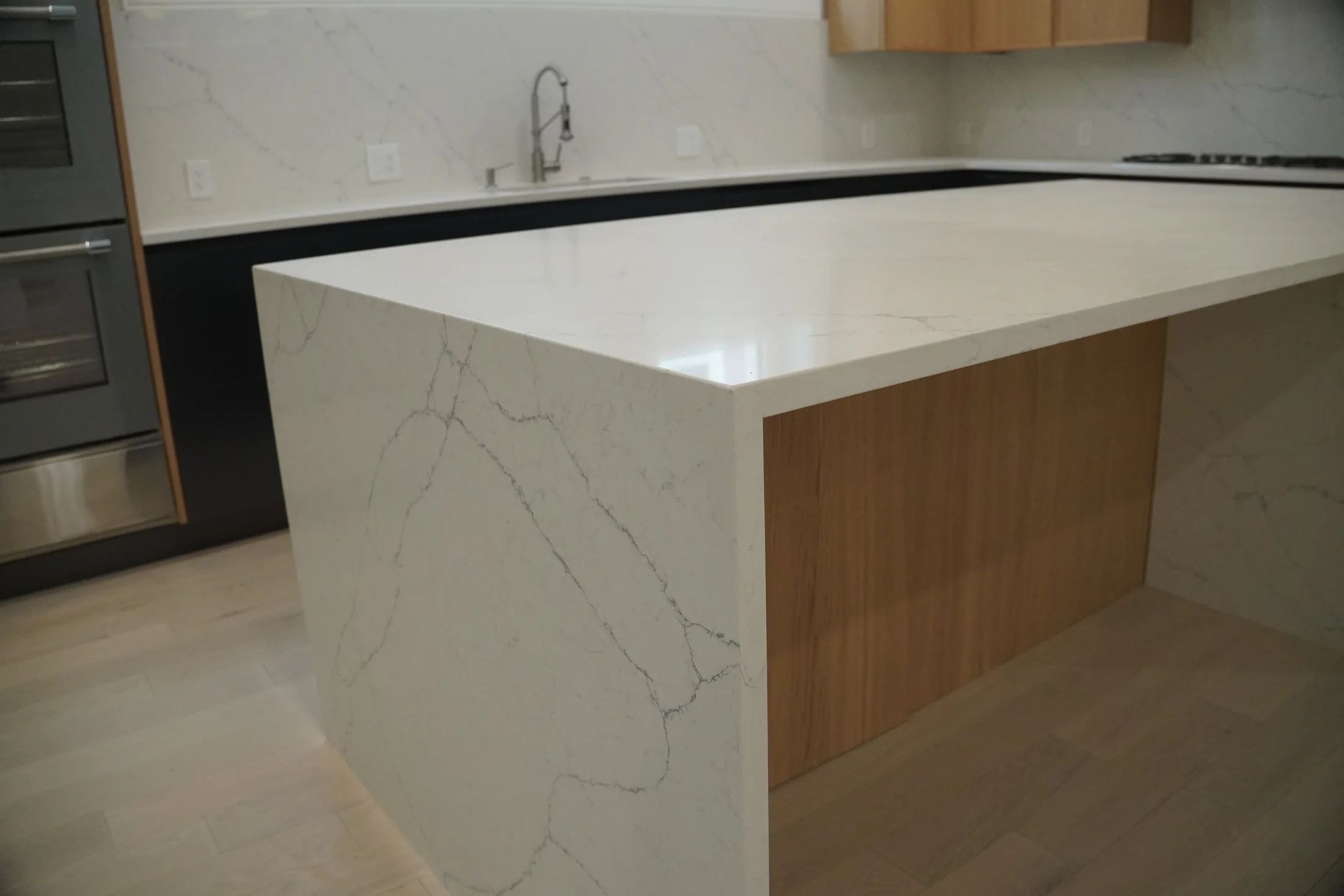
A waterfall island carries the worktop over the end of the island and straight down to the floor, so the top and the side are one continuous surface. It is one of the most recognisable details in a contemporary kitchen. It is also a decision that is usually made too late, after the island cabinetry has been drawn around a conventional worktop, when it is harder to do well.
What the waterfall changes
The edge of an island decides how heavy the room reads. A waterfall return closes the volume, so the island reads as a solid block of material. A thin square edge with an exposed cabinet end leaves the island visually light and lets the cabinetry underneath show. Same slab, same finish, different room.
That makes the waterfall a question of proportion as much as style. In a large, open room, a solid block can anchor the space. In a tight kitchen, two waterfall ends can make the island feel bigger than it is. The island sizing guide covers the clearances that come first.
Why porcelain suits it
The veined waterfall surfaces in our Brookline showroom are large-format porcelain, and we identify them as porcelain rather than calling every veined surface marble. Large-format porcelain lets one visual idea continue across a large surface, which is what a waterfall needs: the top and the side read as one piece. Porcelain also brings resistance to heat, stains and everyday wear, though performance varies by product and thickness, so the exact slab is reviewed for each project. The materials page explains how we specify it.
The vein has to turn the corner
On a veined surface, the most important detail is the corner where the top meets the side. Ideally the pattern flows over that corner as if the slab had been folded. That only happens when the top and the side are cut from adjacent parts of the same slab and the layout is planned so the veins line up across the joint.
Ask to see the slab layout with the cut lines drawn on it before fabrication. It shows where the top, each waterfall side and any seams fall, and whether the vein will match at the corner. A layout that ignores the vein can produce a corner where the pattern simply stops, which is very visible on a surface that is meant to look continuous.
The mitre and the edge
The corner itself is usually a mitred joint, with both pieces cut at an angle so they meet in a sharp, continuous edge. Because decorated porcelain carries its pattern at or near the surface, the mitre has to be cut and finished carefully to avoid exposing the body of the slab at the edge. That is fabrication work, and it is worth asking your fabricator how they detail and protect the mitre on the product you chose.
The thickness of the slab and how it is supported also need review. A waterfall side carries load down to the floor and is exposed to knocks from stools and feet, so the substrate, the edge and the floor junction should all be specified, not improvised.
Plan the cabinetry with it
A waterfall end has to be drawn into the island cabinetry from the start. The cabinets stop short of the side panel by the slab thickness, the drawers have to clear it, and any seating overhang has to be planned so the waterfall still meets the floor cleanly. The island pictured above sets a warm wood panel into the side of the island below the worktop, so the cabinetry and the porcelain meet as two deliberate materials rather than one hiding the other.
One end or two is a design choice. A single waterfall end against a seating side, with the cabinet end exposed at the other, can balance a room. Two ends make the island fully monolithic.
Questions to settle before the island is drawn
- One waterfall end, two, or a thin square edge?
- Which porcelain product and thickness, and who fabricates it?
- Where do the seams fall, and will the vein match at the corner?
- How is the mitred edge detailed and protected?
- How do the drawers, seating and floor meet the waterfall side?
A waterfall reads differently at full scale than in a photograph. You can walk around porcelain waterfall islands in our Brookline showroom. Bring your island plan to a complimentary design consultation at our showroom at 20 Boylston Street, Brookline, and we will look at the edge, the vein and the cabinetry together before anything is drawn for production.